4 - Chords: making a chord progression more interesting
In the last chapter, I tried to explain the fundamentals of writing a basic chord progression. In this post, I will show you how we can make it sound more interesting, by introducing all kinds of variations.
Note: My chord progression example is based on a ternary pattern introduced optionally at chapter 2. But it works exactly the same with any grid or time signature!
What we start from
As a reminder, here is the chord progression we ended up with in the last chapter:
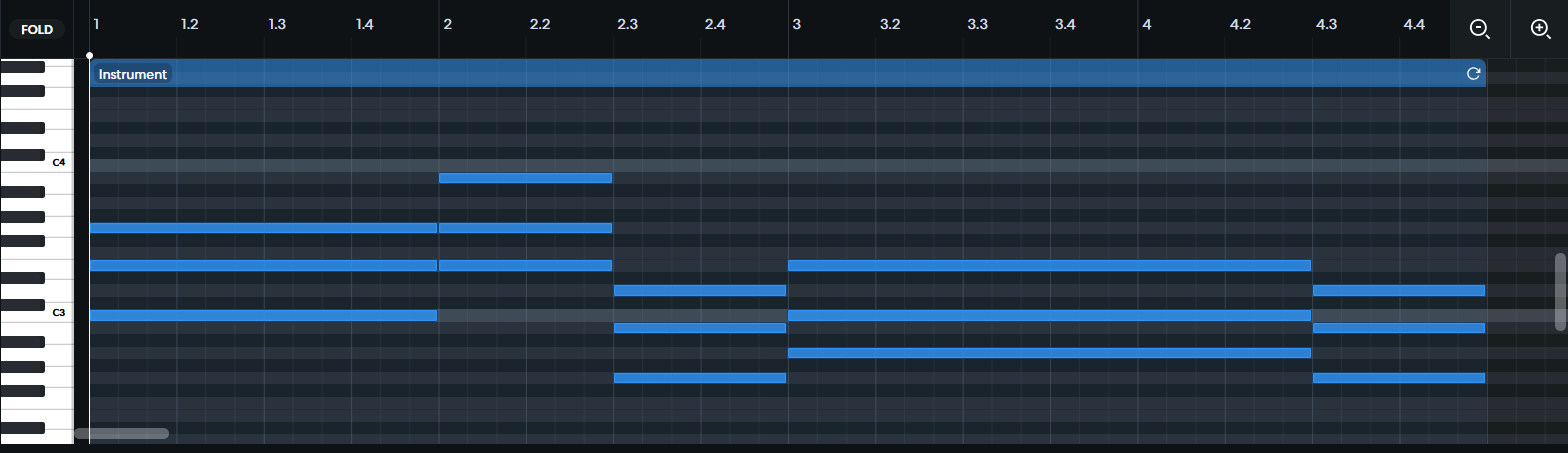
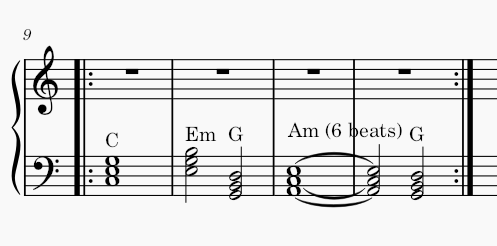
It sounds good, and actually some songs keep things simple like that. However, it is totally possible and easy to make it slightly more sophisticated, without compromising on the simplicity of it.
Chords variations, or how to season your chords
With a bit of seasoning, this is what I personally came up with (I added the drum loop from chapter 2 in the audio):

Variation inside the chord progression
Let's first focus on the first iteration, to talk about what we can change on the chord progression itself.
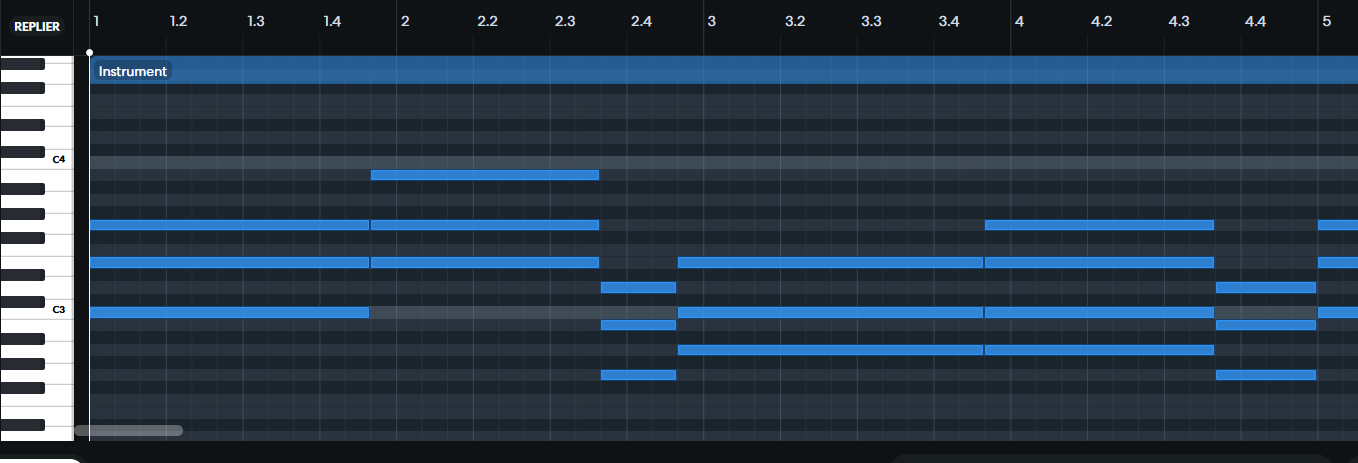
The first useful tip is to change where chords start and stop. Notice how the first chord, C, ends slightly before the next bar. At the same time, the next chord, Em, starts slightly before as well to adjust the change. This kind of basic anticipation breaks the monotony a bit. I did it quite a lot here, to it sounds a bit like I shifted the whole pattern and only created the effect at the start. But you can do it much more sparingly, it will still sound good. I also shortened the two G chords, they are now more like transition chords, which also conveys some kind of nice melody.
Another thing you can do is to alter the chords themselves. There are a lot of different types of chords, and I don't know most of them (Wikipedia and this article alone prove it). I don't want to learn them all either. Instead, I follow those three approaches:
- Trying random things: it might sound stupid, but sometimes it works. I discovered nice patterns that way! I will admit though that it is harder to find something that sounds good that way when you begin. Still, I did use this technique from the very start, and it did help me a lot!
- Doing some research on the genre I target: Sometimes genres have chords typically used with them, or signature patterns that makes you immediately say: that's this genre. It can give you a hint at how to tweak your chords, or even give you a recipe.
- Keep in mind a short list of chords you love, or know what they do: basically
make yourself a cheat-sheet (in your mind or on paper!). Here are some examples (I will use C as a basis for
the examples):
- Major seventh chord (like CM7): Sounds dreamy (used in Animal Crossing music at sunset for example).
- Minor seventh chord (like Cm7): Signature chord of blues, quite common in general, sounds happy and sad at the same time. I use it at bar 4 with a Am7.
- Suspended chord (like Csus4 or Csus2): Sounds happy (or dreamy/strange in some contexts), and like a teaser to something coming after.
- Diminished chord and Augmented chord (like Cdim or Caug): Fear, stress, tension, suspense, you name it. You can't miss it. It sounds like you messed up, but no. Also contains the tritone, which was associated with the devil at some point in the Middle Age.
Variation across loops (OPTIONAL)
Another good thing to do sometimes is just to have variations of the same chord progression to make something bigger and less repetitive. It isn't as efficient as a 8 bars chord progression written from the ground up, but it still makes it sound less repetitive.
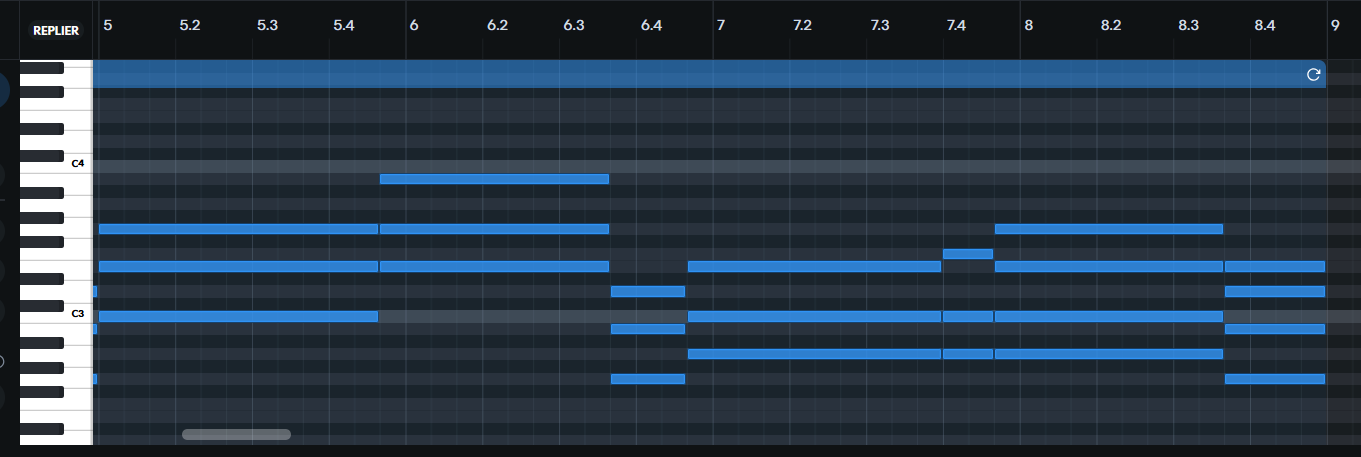
Here, I add a transition chord at 7.4 between Am and Am7. That's an example of a random experiment I liked (it could be a bunch of things but here the fact that it sounds good is enough for me, I won't make a music sheet out of it so...). I also turned the last G into a G6. It makes some variation, ease transition with Am7 through the shared E, and creates a surprise that still sounds good (another randomly good finding here!).
Tip: A music that is too predictable can become boring, so don't hesitate to surprise your listener! Add unexpected things here and there.
Closing words
With all that said, you now have some tools to make more spicy chord progressions! It is ready for our next chapter: the melody and the bass line! As always, don't hesitate to ask questions, and do not worry if you read through it without understanding much of it. It is my fault for choosing such a hard blog topic after all.
Anyway, now I only have to wish you a good day, afternoon, evening or night, and I see you in the next post! (Or in the comments!)
~ Charly
PS: Complain as you want, the post is shorter for the second time in a row 😉. Twice shorter than the last one actually.